



Seminarium dotyczące wnioskowania przyczynowego w badaniach edukacyjnych z udziałem dr. Rolfa Strietholta (IEA)
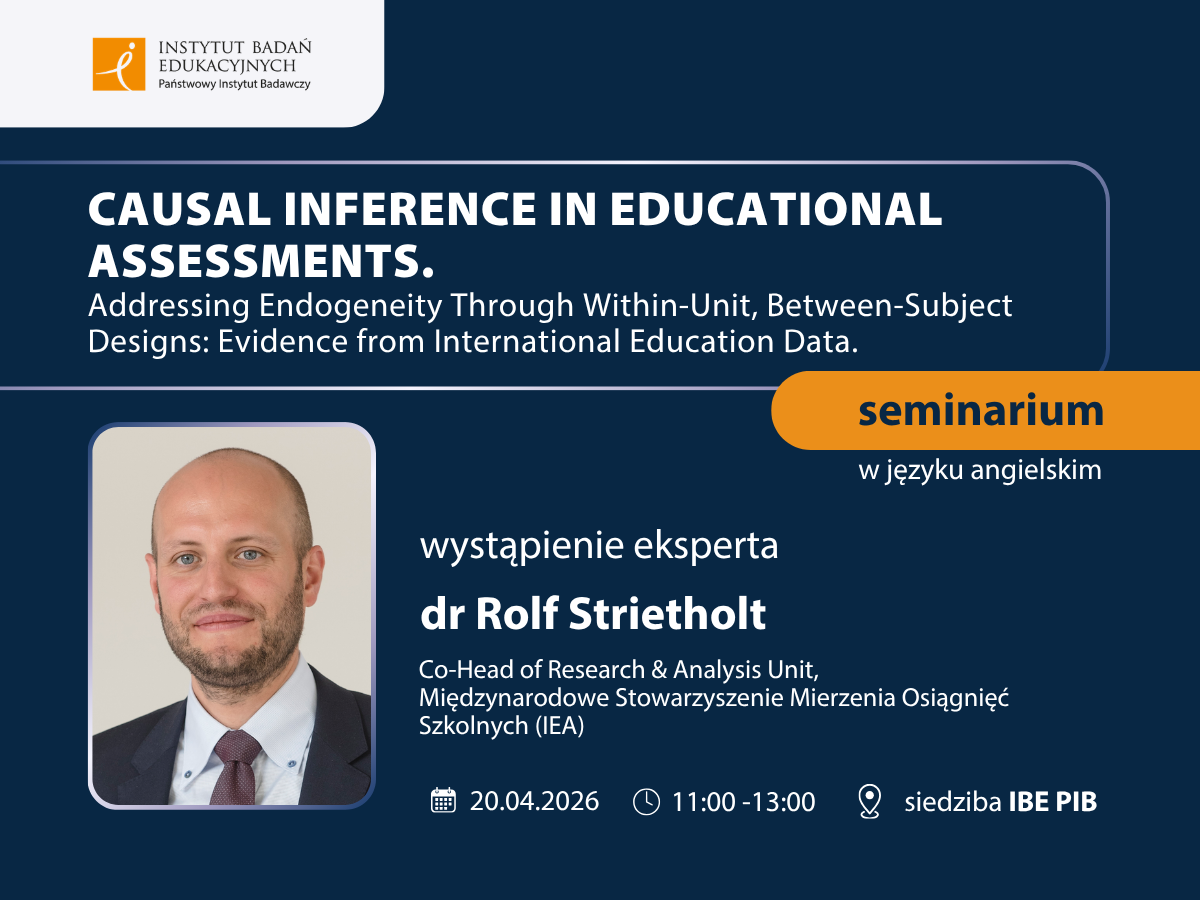
Serdecznie zapraszamy na seminarium, w którym udział weźmie dr Rolf Strietholt z Międzynarodowego Stowarzyszenia Mierzenia Osiągnięć Szkolnych (IEA). Seminarium odbędzie się w siedzibie IBE PIB w poniedziałek 20 kwietnia 2026 w godz. 11.00 – 13.00, w sali B9 (parter).
Spotkanie będzie prowadzone w języku angielskim. Rozpocznie się od wprowadzenia przez dyrektora Instytutu, dr. hab. Macieja Jakubowskiego, w problematykę wnioskowania przyczynowego na podstawie danych z międzynarodowych badań edukacyjnych. Następnie dr Rolf Strietholt przedstawi strategię identyfikacji efektu przyczynowego w schemacie wielopoziomowym, ilustrując ją dwoma przykładami zastosowania w badaniach międzynarodowych. Na koniec przewidziany jest czas na dyskusję.
Uprzejmie prosimy o potwierdzenie obecności na adres:
----------------------------------------------------
PROGRAMME
Causal inference in educational assessments. Addressing Endogeneity Through Within-Unit, Between-Subject Designs: Evidence from International Education Data.
Introduction
Dr hab. Maciej Jakubowski, Director, Educational Research Institute – National Research Institute
Addressing Endogeneity Through Within-Unit, Between-Subject Designs: Evidence from International Education Data
Dr Rolf Strietholt, Co-Head of Research & Analysis Unit, International Association for the Evaluation of Educational Achievement (IEA)
Discussion
ABSTRACT
Addressing Endogeneity Through Within-Unit, Between-Subject Designs: Evidence from International Education Data, Dr Rolf Strietholt, Co-Head of Research & Analysis Unit, International Association for the Evaluation of Educational Achievement (IEA)
Endogeneity from unobserved confounders is a central challenge in estimating effects in education research. This talk examines the within-unit, between-subject design as an identification strategy that addresses endogeneity at different levels of analysis. I draw on two applications using international large-scale assessment data. The first exploits within-country, between-domain variation in curriculum content coverage to address country-level endogeneity — removing confounding from national characteristics such as culture, wealth, or institutional quality that simultaneously shape curricula and achievement. The second exploits within-student, between-subject variation in early home learning activities to address student- and family-level endogeneity — eliminating bias from socioeconomic status, general ability, and other household factors. Both applications share the same identification logic: differencing across subjects within a unit removes subject-invariant confounders. I discuss the assumptions required, the remaining threat from subject-specific endogeneity, and practical considerations for applying this design to observational data.
Informacje dotyczące wydarzenia
| Rozpoczęcie | 20.04.2026 11:00 - 13:00 |
| Lokalizacja | Warszawa |
| Projekt | Seminarium, IBE |